Reading Reviews (Or, Reviews of Poetry Readings)

The Reading Series Presents Pearl Pirie and Mike Caesar
Hosted by the In/Words Magazine & Press editorial team

November 25th, 2015

For a number of years, the In/Words editorial team (or a group of people relatively associated with In/Words Magazine & Press) has been organizing a reading series and open-mic in the basement of The Clocktower Brew Pub on Bank Street in the Glebe, usually on the last Wednesday of every month. In its current formation, it seems the entire editorial board takes a role in organizing and hosting the evening in the dark bar basement. For the event in November, a significant line-up of widely-published poets as well as a musical act promised an interesting evening of poetry at a reading series that usually finds comfort and community with university student features.

Soundtrack sets the mood, Mike plays Call of Duty

As a new (or very, very infrequent) feature to this reading series, some live music performed by Scary Bear Soundtrack greeted the audience as they arrived, ordered drinks, and chatted. For a reading series that operates out of a bar basement and that starts at 9PM, it was unsurprisingly fitting for the musical act to fill the room with some instrumental music while conversation and libations prepared the audience for the reading. Although Scary Bear Soundtrack was performing as a solo act with Gloria Guns playing keys and vocals, the music was upbeat and dreamlike and well suited to set the evening’s mood.

With an abrupt cut from the musical performance, In/Words editor Drew Douglas jumped on the microphone to introduce the evening’s first reader and guest opening act, Mike Caesar. While Caesar’s poetry plays with rhyme and assonance, which keeps his largely narrative poems interesting, the performance of his poems are fairly straightforward. Reading off a page, Caesar’s deep voice makes his poems interesting in the way that it emphasizes the delivery of every single word, much in the same way that everyone is interested in Morgan Freeman’s naturally intriguing speaking voice. Yet, Caesar’s best performance is saved for the end of his set when a poem briefly lists words used to describe wine, such as “barnyard” or “plonk.” Overall, Mike Caesar’s articulate poems made for an interesting opening to the night’s poetry and performance, and, while he is a fine reader of his own poetry, the craft of the poem on the page had to carry the weight of Caesar’s reading in general.

Part Radish, part Review, part Salamander
image

Either in the organizers’ efforts to share hosting responsibilities, or as a representation of who coordinated which reader’s appearance at the reading, Sanita Fejzic introduced the night’s featured reader, Pearl Pirie. Sanita prepped the crowd with a pleasant personal anecdote on how she met and came to be familiar with Pirie, who was also launching a new chapbook with In/Words Magazine & Press, titled Please don’t tickle the salamander’s belly. As a relatively experienced poet and reader of her own poetry, Pirie seems fairly set in her performance style; she appears to know her poems well and reads quickly though moments of quick wit and punchy humour (i.e. “… never schedule a haircut / while your stylist is going thru a divorce.”). Pirie also keeps her banter between poems to a minimum, largely keeping attention on the poems rather than getting derailed on personal anecdotes, thoughts, or updates on the news or whatever; however, Pirie did share an amusing anecdote on a review of her BookThug collection, the pet radish, shrunken, who thought the title (and title poem) of the collection was a reference to the testes.

Nevertheless, it is the interest in sound and word play that keeps Pirie’s poetry and performance interesting. As a poet who seems to always have new work in the form of a new collection or chapbook, it was nice to hear Pearl Pirie read again from the pet radish and her Shreeking Violet chapbook (which was briefly reviewed by rob mclennan here). After Pirie ended her reading, In/Words editor Jennifer Greenberg plugged the upcoming launch of In/Words Magazine 15.1 before beginning a short break in the evening, allowing for the audience to take a breath and absorb the readings from the featured readers. Douglas also jumped on the mic again to provide a short bio of Scary Bear Soundtrack who once again filled the break with their synth-driven shoegaze.

An “Awesome” (ASM!) open-mic

The Reading Series, with its association to the Carleton University-based In/Word Magazine & Press, has a regular crowd of young poets and performers who are themselves students of Carleton U. In the open-mic, some poets, like Jeremy, have ongoing jokes with members of the audience, like the consistent request of Jeremy’s popular Sea World poem. Another occasional attendee and open-mic reader, Asm, shows up to blow the room away with his undeniable adoration of the art and craft of poetry. Open-mic readers like Asm can make the room blush and really appreciate the existence of poetry readings with open-mic segments. Other readers, like “Dante” or the misnamed Greg, can break out surprising open-mic performances that display real humour from a younger ilk of current writers. However, these performers either lack the confidence or for some other reason always undercut their intelligence either in the introduction to their open-mic performances or in their strict rhyme structure or simplistic poem composition. This is why local poet Ian Martin is one of the most interesting writers attending The Reading Series; not only is Martin writing tight, image-driven poetry, but he also seems to continue experimenting and uses open-mics to try out these experiments, such as his use of this month’s Reading Series to try out a humourous script.

In the end, In/Words’ The Reading Series is a fine and fun event, usually with a young and lively crowd who are generally respectful of and interested in the readings of feature and open-mic readers. Check out Pearl Pirie’s apt summary of the November event (with pictures!), and look out for the next iteration of The Reading Series in January.
Life After English, Part 2: Advice from a Has-Been (and Some Quotes from Actually Successful People)

At this time last year, just a few short months into my position as Coordinating Editor for Arc Poetry Magazine and a few even shorter months after graduating from the Master of Arts program, I was surprised to be asked to deliver another speech for a “Life After English” event (see here for my first speech about my early experiences in an MA program) about my experiences in the “professional” world, or something. Although I’m pretty sure I ended up winging most of the speech at the time, I thought I would post the material I had prepared, in case someone at the English Department at Carleton University is (for some reason) thinking about asking me to talk again at one of these events. Enjoy!

First off, I would like to thank Lana Keon for contacting me about this event, not to mention everything that she does in the department, and thanks to Professor Brian Johnson for asking me to speak here today. When I was asked to speak about the last few months after completing my MA in English, I said to myself, “Self, you just gave a talk at this Life After English event last year, speaking as a student currently in the Masters program. What the heck are you going to say this year?”

Well, I thought about talking about volunteering to gain experience. Then I thought I might sound a bit like that jerk governor of the Bank of Canada. So, then I thought I’d talk about the intricacies of Christopher Nolan’s space-travel nail-biter Interstellar, but that doesn’t seem to be relevant to anything at all. So, finally, I landed on just telling a story… a boring, semi-literary, largely narcissistic story.


“Be yourself; everyone else is already taken.” — Oscar Wilde


That’s the story I want to tell you. Well… with some exposition. I want to tell you the story of how being completely myself and only slightly other people throughout my university career has resulted in a job with a nationally distributed poetry magazine and with other writing contracts keeping me busy and using words in a slightly similar way to writing essays.

In the three or four months since I’ve finished my Masters Research Paper (one thing I can tell you with certainty is that the distinction of passing time does not improve post-graduation), I have been working with Arc Poetry Magazine as their coordinating editor, which isn’t so much of choosing what gets published, or even (surprisingly) editing work, as it is a job that requires knowledge of magazine production, organizational skills, and kick-ass email composition. I also started working at a small paper boutique in the Glebe, which is irrelevant to anything to do with my degree except for the funny little coincidence that books are made with paper. And most recently I have also taken on other writing jobs for a company that specializes in Search Engine Optimization, which is a funny little skill that doesn’t make very much sense until it does. All of these jobs that have been seeming to fall into my lap when I haven’t been looking, but that doesn’t mean that I’m not qualified. I also never expected this relevant employment. Someone could say I’m lucky and not be too wrong. Someone else could say I’m tall and not be the first one who has ever told me that.

The technical skills I learned in my English degree (i.e. the ability to write clearly and convincingly, using proper grammar, spelling, etc.) have not earned me any great praise in these three jobs. It might just be me, but these skills are expected from anyone who is educated higher than a fifth-grade level. It might also just be me, but I expect a lot from ten-year-olds.


“It’s not what the world holds for you. It’s what you bring to it.” — L.M. Montgomery, Anne of Green Gables


The one thing about my English degree that has served me best in my post-graduation employment has been the commoditization of my genuine interests in things that I only could have learned about in the study of English. The theoretical and generic avenues I chose to pursue through a genuine interest in Canadian poetry and other forms of literature have been the largest proponents of my success at finding a job in my field post-graduation. It was because I have a passion for poetry that I focused my education on poetry. Even further than that, it was because I have an interest in publishing and magazine production that when an opening at a Canadian poetry magazine popped up, it was a sure thing—a perfect fit—for me to fill that role in the editorial team.

That’s the one thing I hope to encourage you to take away from my little talk today: you should never assume you’re entitled to anything, but never think that you aren’t qualified for something.


“The problem with the world is that the intelligent people are full of doubts, while the stupid ones are full of confidence.” — Charles Bukowksi


You are always going to be the best judge of what you’re the best at, so why not pursue activities that interest you, cater to your tastes and abilities, and further your experience in some way. When I said earlier that it seemed like things fell together without much effort, I was exaggerating slightly; a perfect job is never going to literally fall into your lap… because that might be dangerous and even fatal. What I am saying, though, is that you shouldn’t be afraid to specialize yourself and pursue your personal interests because being unique, knowledgeable, and passionate truly are endlessly rewarding qualities to possess in the professional world, and in life!


FOLLOW YOUR PASSION! CHASE YOUR DREAM! NOBODY’S BETTER THAN YOU AT BEING YOU!

“A single fantasy can transform a million realities.” — Maya Angelou


“The poem must resist the intelligence almost successfully.” — Wallace Stevens


“You have brains in your head. You have feet in your shoes. You can steer yourself in any direction you choose. You’re on your own. And you know what you know. You are the guy who’ll decide where to go.” — Dr. Seuss, Oh the Places You’ll Go!


“Each new hour holds new chances / For new beginnings. Do not be wedded forever / To fear” — Maya Angelou, “On the Pulse of Morning”


“To be nobody-but-yourself—in a world which is doing its best, night and day, to make you everybody else—means to fight the hardest battle which any human being can fight: and never stop fighting.” — e.e. cummings, “A Poet’s Advice to Students”


“We do not need magic to change the world, we carry all the power we need inside ourselves already: we have the power to imagine better.” — J.K. Rowling, Harvard commencement speech, 2008


“The only way to make sense out of change is to plunge into it, move with it, and join the dance.” — Alan Watts, The Wisdom of Insecurity


“Everybody has a secret world inside of them. I mean everybody. All of the people in the whole world, I mean everybody—no matter how dull and boring they are on the outside. Inside them they’ve all got unimaginable, magnificent, wonderful, stupid, amazing worlds… Not just one world. Hundreds of them. Thousands, maybe.” — Neil Gaiman, The Sandman, Vol. 5: A Game of You


“Our fearlessness shall be our secret weapon.” — John Green, The Fault in Our Stars


“The human face has limited space. If you fill it with laughter there will be no room for crying.” — Rohinton Mistry, A Fine Balance


“Don’t let the bastards grind you down.” — Margaret Atwood, The Handmaid’s Tale


“Our battered suitcases were piled on the sidewalk again; we had longer ways to go. But no matter, the road is life.” — Jack Kerouac, On the road


“The things that make me different are the things that make me.” — A.A. Milne,Winnie-the-Pooh


“A life without challenge, a life without hardship, a life without purpose, seems pale and pointless. With challenge come perseverance and gumption. With hardship come resilience and resolve. With purpose come strength and understanding.” — Terry Fallis, The High Road


“You must take life the way it comes at you and make the best of it.” — Yann Martel, Life of Pi


Upcoming Reading at blUe mOndays

12074638_10153558004840821_5483939398748526463_n

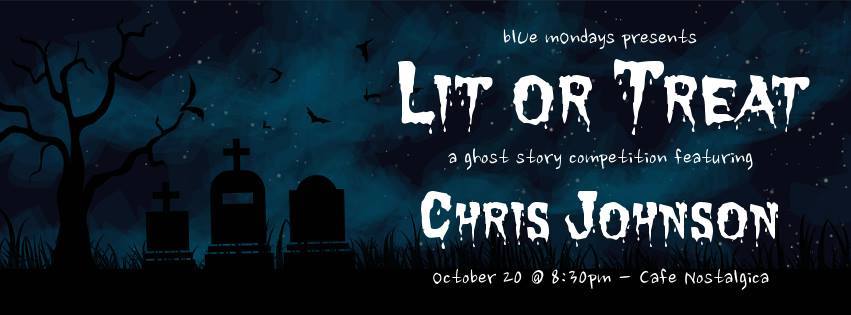
After quite a bit of silence, I’m hoping to become a bit more active and present, not only on this blog (with reviews and updates and commentary) but also in my writing. To start this off, I’m chuffed to be the featured reader at blUe mOndays’ October reading. Come on out to Café Nostalgica on October 20th (the day after you should be voting at the polls for a new leader in the Canadian government) and read at the open mic, listen to some spooky poetry and fiction, and have a drink or two.

See you soon!

Old News, New Reviews

JM Francheteau’s A Pack Of Lies (Dog Bites Cameron Books, 2013)


There are a few things that are not important to this review of JM Francheteau‘s A Pack Of Lies: 1) the order of the poems in the chapbook; 2) the ability to read the poems without hearing Francheteau’s voice reciting them in various alcohol-soaked venues; and, 3) the completion of a numbered summarization of the book. As a collection, Francheteau’s debut poetry chapbook is meant to be an assembly of tall tales and meditations that does not progress in any direction, but develops like a conversation with a (slightly drunk and white-trash) story-teller who drawls on into the night with a twinkle in his eye that insists the lesson in his ramblings may be a bit deeper than you think. Francheteau crafts this voice with such precision and subtlety that, even if a narrative presents a buffoonish cast of characters, you can never be exactly certain that you are completely smarter or better than a poem’s speaker.

There is a fine line between intelligence and foolishness in A Pack Of Lies. Or it might be ignorance and experience. Or it might also be inexperience and a different kind of inexperience. Take, for example, the speaker in “James, who was pale and American,” and his recollection of his friendship with the poem’s title character. In the formation of the poem’s speaker, he remembers the influence of someone with different—and seemingly, though falsely, larger—intelligence than him:

James knew things I didn’t, like what an American
was, and why being one meant you had to go sit
in the coatroom while “O Canada” wheezed each morning.
I had a strange name and a mushroom cut, and believed him.

Francheteau fills A Pack Of Lies with these types of characters: people who appear more knowledgeable than others, or who can easily lie to cover up where their knowledge is lacking. It is inevitable that there are things that we, as people, are going to miss in our lifetime, but Francheteau’s characters want to know, see, and experience it all. Even the speaker in “For Robert Kroetsch, From Whom I Have Stolen” pretends—though he acknowledges that he has “never met Robert Kroetsch”—that he can still address the renowned Canadian poet and somehow have his words heard. This begs the readers to ask themselves, what is so bad about a lie that we tell ourselves? If we believe tall tales and staged wrestling matches, why can’t we also believe that we can meet dead historical figures, or that we will each be remembered long after we die? Though he may not believe it himself, Francheteau seems to want to believe that “pissing [his] name in this snowbank / [won’t] be all the mark [he] leave[s] here.”

Although I argue that it is this existential question that stitches together A Pack Of Lies, Francheteau’s strength in this collection is surely in his narrative poems rather than his meditative moments. Although the tongue-in-cheek sentiment of the poem glued to the back cover of the chapbook-box—”To the Person Considering Buying this Book at the Rummage Sale”—proves that Francheteau can carry his humour over from his narrative pieces to his addresses, pieces such as “Advice for Brood II” and “Albedo” stand out as almost incomplete narration. These pieces see Francheteau’s manipulation of an internal monologue, or an unspoken address, into a curious meditations on the existence of the things or people outside of the speaker’s own mind:

                that smudge on my window so long ago
was some trace of your body,
of your being
there:

that’s what I like to imagine,
from time to time.

Here, the speaker of “Albedo” recalls a series of memories that he is unsure about, simply because they are not his memories, just presumptions of possibilities for a life of a woman (the speaker’s sister?), who left and disappeared out of the speaker’s ability to follow her existence: “Maybe that change bought you a Greyhound / into the ventricles of America”. To say that this poem is solely about connection might be a half-truth; just as we are unable to know everything or be everywhere, Francheteau’s speakers face this daunting experience that, regardless of our connections with one another, there is truthfully little about our family and our friends—and especially celebrities—that we can know with certainty.

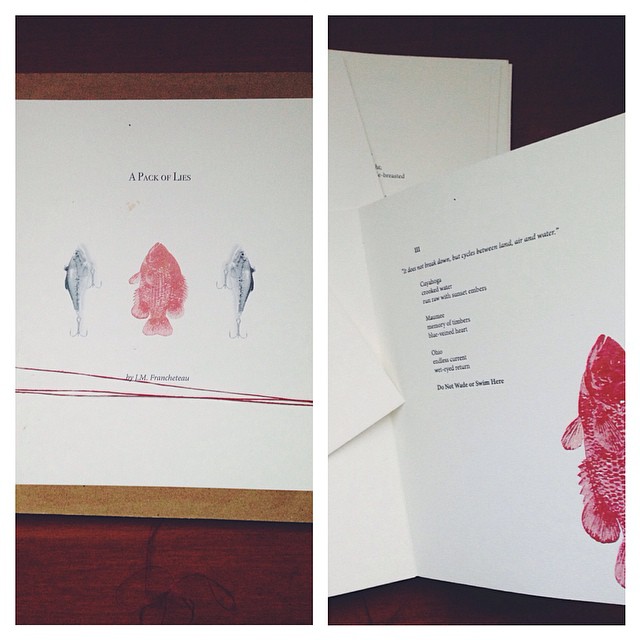
As a book-object that will outlive its author (and most of its references), Dave Currie and Lara Wlodarczyk at Dog Bites Cameron Books designed a chapbook that doesn’t look like a chapbook for poems that don’t always insist themselves as poetry. Bound in a cardboard box with loose-leaf pages containing each poem, there is no numbering or binding to direct the reader in an order. This, along with the insert of a web-link and download code for audio files of Francheteau reading his poems, insist that this collection requires a more tactile and/or aural engagement. There is something performative about the poems that is emphasized by these unique features to Francheteau’s book. Though difficult to get ahold of, A Pack Of Lies is a beautiful read, though you should be warned that existential crises are not welcome.

Life After English

At this time last year, I was a few months into my Masters degree and preparing to speak about the MA program at Carleton University English Department’s Life After English event. Today I will be speaking at the same event as a graduate from the MA in English program. To honour this huge mistake on behalf of the English Department, I thought I’d post here my speech from 2013. Enjoy!

First off I would like to thank Professor Whiting for asking me to speak at this event, and I would also like to thank all of you for coming. As a warning, this talk might be a little focused on my experiences. Just thought I should give you a warning or a MPAA rating of sorts (the next twenty minutes has been rated Slightly Narcissistic) because what this talk is really supposed to be is something that will prove helpful to you as a person. Choosing what post-grad path to pursue is difficult, and events like this where you can talk to people who were recently in your very position is unbelievably helpful. I’m really approachable, so if you have any questions, just ask. Yell at me on the street. I’ll do my best to answer. As a part of the Life After English lecture series (?), I am here to talk to you about the English M.A. as a possible (or probable?) venture after finishing a Bachelor’s degree here at Carleton.

So, a course-work based Masters program is exactly like doing a second fourth-year, except that it’s nothing like doing a second fourth-year. Basically, the structure is more-or-less the same; your grades are based on seminar presentations, final papers, class participation, and perhaps some other assignments.

Sure, there are fewer classes with far fewer students sitting around the table, but believe you me, this means that expectations are drastically higher. This is the unspoken obligation of entering into an M.A. program: you have to step up your game significantly. While thinking about what I was going to say today, I asked a friend, “what does a good propaganda speech need?” She said, “always a good idea to have something akin to a thesis statement,” and I thought to myself, “Damn, I probably should have thought of that.” That is the kind of thought that you probably shouldn’t still find yourself thinking half-way through your Masters program. When I say that an M.A. asks you to step up your game, what I really mean is that you shouldn’t keep saying, “Damn, I should have thought of that.” Nevertheless, it’s a thought that I apparently cannot shake. This talk is going to explain how becoming a graduate student usually results in a development of impostor syndrome, the feeling that but not knowing what you’re doing is not necessarily always a bad thing.

Entering into a Masters degree is a good idea for both the extremely passionate and the severely indecisive. Luckily, I am both. (It’s also a good idea if you want to postpone coming to terms with your ridiculous burden of student debt, but that’s beside the point.) I’ll dismissively tell you later that I decided to apply to the M.A. program at the last minute (don’t know if crippling indecisiveness is a thing, but I guess I identify with Price Hamlet), but that does not mean that I am not happy to be where I am.

The current student blogger for the English department said in one of her recent posts that she is taking a degree in English because “reading is fun”. This is true: reading is fun, and it will continue to be fun, I promise. If you’re doing it right, taking an English degree means signing up for courses that genuinely pique your interest and contain assigned texts you’ve always wanted to read and/or study. This is also true for an English M.A. Throughout my B.A., I noticed a progressive specialisation of course content, which allowed my study in the later years to focus on texts and subjects that I was genuinely interested in. So, it may go without saying, but I’m pretty passionate about literature, and continuing on to my Masters degree has started a whole new chapter in my academic writing career that I am embarrassed to say I actually don’t hate… all the time.

Now, don’t take my strange and masochistic academic pleasure to mean that I am notably talented in English. When Professor Whiting asked me to speak on behalf of the English M.A. program I was sure one of us needed to be placed on a 72 hour hold: either I was hearing things or she was making a big mistake. You see, I was ineffably nervous when I applied to the English M.A. program. I looked back on the less-than-solid-might-have-been-an A- average of my undergraduate degree and said to myself, “Self, you are surely the most inadequate person to be in a Masters program, let alone competent enough to be telling undergraduates about a Masters program.” However, this feeling of inadequacy and unsuitability is apparently common. In fact, the first thing I learned upon entering this program was that everyone shared the feeling of being a fraud or an impostor. I had the distinct impression that the achievements that had brought me to where I am now were based on luck, and that I was running out.

In fact, I Googled “impostor syndrome” in preparation for this talk (because no matter what level of study you reach, a Google search will always be the quickest way to research a topic) and clicked the second link that appeared. It led me to a website for a book by “impostor syndrome expert Dr. Valerie Young”. The promotional material was steeped in a kind of emotions behind the words, witness to my experience, kind of thing, but effectively said, “You may feel like a fraud but in truth your fear of being inadequate pales in comparison to your fear of being extraordinary.” Now, I would never call myself extraordinary, but there is definitely a shared feeling amongst new students of an M.A. program that any past successes are no longer noteworthy and that there is no reasonable way to live up to the new academic expectations.

So, moving from a B.A. into a M.A. seems, at first, like only a minor change. Perhaps if you have ever taken a full course load of English classes then you won’t feel overwhelmed at all. The required reading class-by-class is about the same if not a little more than any fourth-year English course. So, no big deal; all is well. It’s just the same old same old. Chim-chim-cheree, right?

Well, I would be lying if I said that the expectation is the only thing that changes between a B.A. and the M.A. in English. The biggest change I have experienced in my transition has been the importance that literary theory plays in every course. Now, if you are at all like me, that one literary theory course that you’re required to take in third-year was the extent of your interaction with the many different branches of literary theory. And even the theory in that course was largely ignored, or skimmed and then crammed the night before the exam. So, my undergrad was completed with close readings and a few theoretical hats pulled out for the big papers. (The feminism toque (or wide-brim sunhat with silk flowers, depending on the weather) was a particular favourite wear of mine.) But, in the M.A. program, theoretical texts play a central role in the courses, and a firm understanding is required in order to truly build a solid foundation for your papers. Being able to wield the theoretical subject for use and, in my case, misuse is a truly invaluable tool in an M.A. setting. If anything is sure to make me feel out of place, it will be sitting in a room with academics discussing Foucault’s theory of liminality or Zizek’s reading of the courtly lady; connecting with these theoretical concepts does not come easily to me, and despite assurances from my classmates that they are struggling as well, it’s near impossible to shake the sense that my understanding of Lacan’s description of the mirror-stage will never reach the necessary level. I’m a theoretical fraud and that will likely never change.

This being said, there is still the incredibly supportive and enthusiastic resource of the professors. As they have always said about small classrooms, fewer students means more personal relationships with professors which means more opportunities for one-on-one “what the hell is going on in this text” sessions, as I am now going to start calling them. With help from the departmental support, the great secondary source recommendations, and the similarly confused colleagues, my theoretical fraudulence has improved. Sure, the theories will always be there, and they will always loom in their intellectual superiority, but the Masters program has shown me just how important, relevant, and genuinely interesting literary theory can be when studied and applied in a form that I enjoy. Furthermore, there is also camaraderie between classmates who are always eager to share ideas and opinions on theory or anything else literature-related. Having a supportive environment in which to discuss your passion with people who share it with you is an invaluable advantage of the program. I don’t know if anyone has ever felt that their educational experience has been an elaborate competition—a Hunger Games-esque death-match fought with words (except when racing to the last available library printer), if you will—but my entrance into a Masters program has introduced me to amazingly supportive classmates and faculty mentors. If nothing else keeps you sane during essay season then the sympathy of a group of friends writing just as many terrible essays as you will certainly keep you going. I have learned a lot since being enrolled in a programme as challenging as the postgrad English course, but I think this has been the most valuable lesson so far.

Now, I don’t mean to say any of this to discourage anyone from entering into the English M.A. program; the work I have studied and the essays that I have written in the last four months have been the best of my academic career to date. In specialisation of study and narrowing of research interest there comes an almost paradoxical freedom of thought. In my undergraduate essays, there almost always came a point where I would stop and think to myself, “Self, what the hell are you saying here? Why are you even writing this paper? What the heck do you know about the representation of patriarchal oppression in Shakespeare’s A Winter’s Tale?” In the M.A. program, these thoughts have been less frequent, although not completely absent. Instead, there almost always comes a moment where the entire paper makes sense—a “eurêka” moment, if you will, despite the absence of baths in my enlightenments—and the paper suddenly stops being a bunch of words on a topic and becomes a solid thesis. In this moment, the paper that has been killing you becomes a surprisingly cohesive union of research, knowledge, and interest; a prideful reflection of your hard work and experience up to that point. And that moment almost makes the rest of the work worth it…

…But you shouldn’t be listening to what I have to say! What are you doing? I’m a fraud! I slept and bribed my way to where I am now. That’s a lie, but still— go and ask someone who knows what they’re doing, and if you manage to even find such a person, give me a call. Just because I’ve completed an undergrad and am a TA and sometimes wear a tie, it doesn’t mean I am any more secure in myself academically than I was on my first day of first year. I have friends who have “careers” (whatever those are) who still have no idea what they’re doing, but they’re enjoying it, as I am enjoying this Masters degree, because we have all chosen the paths that suited us. So the best thing I can tell you to do is go and figure it out for yourself. Leonard Cohen apparently said, “Act the way you’d like to be and soon you’ll be the way you act”. With an M.A. program, if you want to be there, you will get there; and if you keep wanting to be there, cheers to you, ‘cause you’ll definitely make it through.